Why Does My Humidifier Make My Air Purifier Go Off?
If your air purifier suddenly kicks into high gear whenever your humidifier is running, you aren’t imagining things. This common reaction happens because particulate sensors in air purifiers often mistake tiny water droplets or mineral dust for harmful pollutants. By adjusting placement and water quality, you can stop these false alarms and keep your home environment comfortable.
It is a quiet evening at home. You have your humidifier running to keep the air comfortable during the dry winter months, and your high-tech air purifier is silently humming in the corner. Suddenly, your purifier goes into overdrive. The fan speeds up, the display light turns red, and it acts as if you just burned a piece of toast in the kitchen. If you find yourself asking, why does my humidifier make my air purifier go off, you are certainly not alone.
This situation is surprisingly common in modern homes as we lean more heavily on smart air quality devices. It can be frustrating to hear your purifier working overtime when you are just trying to add a little moisture to your living space. The good news is that this is rarely a sign that your devices are broken. Instead, it is usually a simple case of a sensor getting a bit overzealous. Let’s dive into the science behind why your devices are having a “disagreement” and how you can fix it.
Key Takeaways
- The Sensor Confusion: Laser particle counters in air purifiers cannot distinguish between harmful smoke and harmless water mist, leading to triggered alerts.
- Mineral Content Matters: If you use tap water in an ultrasonic humidifier, the “white dust” created by dissolved minerals is easily detected by air purifiers as PM2.5 pollution.
- Strategic Placement: Keeping your humidifier and air purifier at least six to ten feet apart prevents the purifier from being overwhelmed by concentrated moisture.
- Distilled Water Solution: Switching to distilled or demineralized water eliminates the mineral particles that often cause your air purifier to spike.
- Sensor Calibration: Most modern air purifiers have auto-adjusting sensors that may require periodic cleaning to maintain accuracy and prevent sensitivity issues.
Understanding the Particle Sensor
To understand why your humidifier triggers your air purifier, we first need to look at how air purifiers “see” the air. Most modern air purifiers rely on laser particle sensors to monitor your indoor air quality. These sensors shoot a beam of light across a small chamber. When particles pass through that light beam, they scatter the light. A detector on the other side measures that scattering to determine the size and number of particles currently floating in your room.
How the Confusion Happens
The core issue is that these sensors are incredibly sensitive, but they aren’t actually “smart” enough to identify what the particles are made of. They only know that something is interrupting the light beam. When your humidifier releases a cool mist into the air, it is essentially filling the room with billions of tiny, microscopic water droplets. From the perspective of your air purifier’s sensor, these droplets look exactly like smoke, dust, or other airborne pollutants. As the mist travels through the air and hits the purifier’s sensor, the device assumes the air quality is poor and automatically ramps up the fan speed to “clean” the air.
The Role of PM2.5 Readings
You might notice your air purifier’s PM2.5 readout jumping from a healthy number like 5 to a concerning 50 or higher when the humidifier is on. PM2.5 refers to particulate matter that is less than 2.5 microns in diameter. Because water mist from ultrasonic humidifiers falls into this exact size range, the purifier interprets the mist as high-risk particulate pollution. It is trying to protect you, even though the “pollutant” is just water.
The Impact of Water Quality
Not all mist is created equal. The type of water you pour into your humidifier plays a massive role in how your air purifier reacts. This is especially true for ultrasonic humidifiers, which use high-frequency vibrations to break water into a fine mist. If you are using tap water, you are likely introducing more than just moisture into your home.
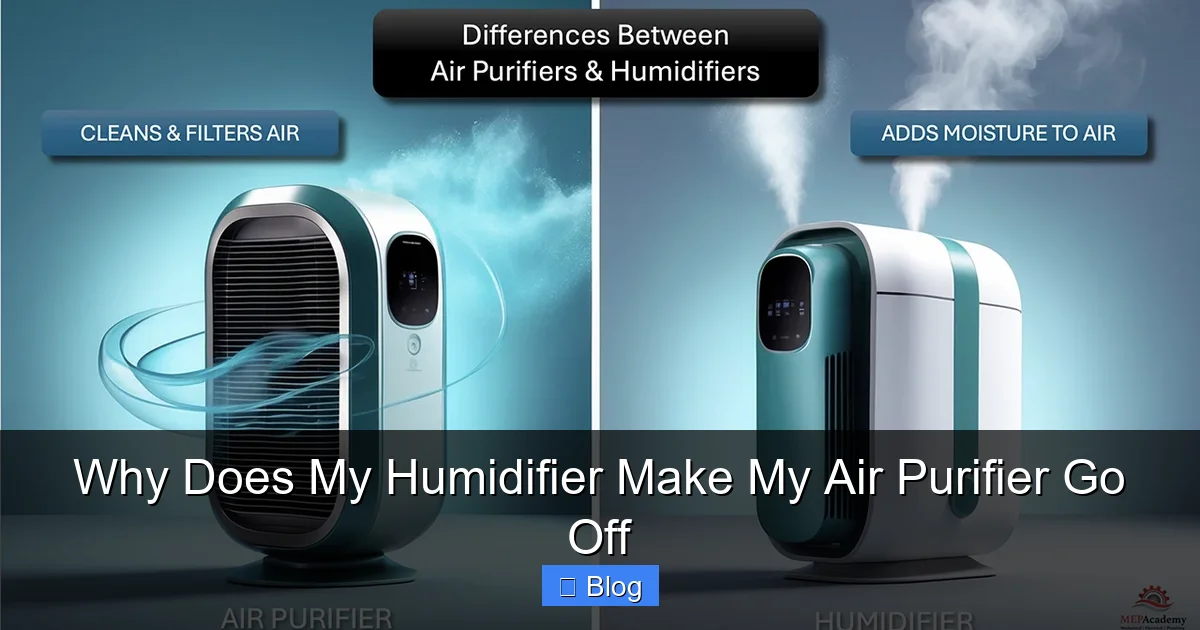
Visual guide about Why Does My Humidifier Make My Air Purifier Go Off
Image source: mepacademy.com
The Problem With “White Dust”
Tap water contains dissolved minerals like calcium and magnesium. When your humidifier turns that water into mist, those minerals are launched into the air along with the water. Once the water evaporates, those minerals are left behind as tiny, dry, microscopic particles. This is often referred to as “white dust.” While you might not see it settling on your furniture immediately, your air purifier certainly sees it. These mineral particles are essentially solid debris, and your purifier’s sensor will definitely pick them up as airborne contaminants.
Using Distilled Water as a Fix
One of the easiest ways to stop your air purifier from reacting is to switch your water source. Using distilled or demineralized water removes these extra minerals from the equation. Because distilled water is pure H2O, the mist it creates is much cleaner. Once the water droplets evaporate, there is no mineral residue left behind to trigger the sensor. Many users find that switching to distilled water reduces the frequency of “false alarms” from their air purifier by a significant margin.
Optimizing Placement and Airflow
Sometimes the solution isn’t about what is in the water, but rather where the devices are located. If your humidifier is sitting directly next to your air purifier, the purifier is essentially breathing in the mist before it has a chance to disperse throughout the room. This creates a highly concentrated stream of particles that will almost certainly trigger the sensors.
Strategic Spacing
Try to create as much distance between the two devices as possible. Aim for at least six to ten feet of separation. This gives the moisture a chance to naturally dissipate into the room’s air. When the mist is allowed to spread out, the concentration reaching your air purifier’s intake becomes much lower, which often keeps the sensor from hitting that “panic” threshold that causes the fan to speed up.
The Importance of Air Circulation
Placement is also about airflow. Do not place your humidifier in a corner or behind furniture where the mist can get trapped. If the air in the room is stagnant, the mist builds up in a concentrated cloud. By keeping the air moving—perhaps by using a ceiling fan on a low setting or placing the humidifier in an open area—you help the humidity balance out more quickly. This keeps the air quality reading on your purifier much more stable.
Managing Sensor Sensitivity
If you have moved the devices and switched to distilled water, but your purifier is still acting up, it might be time to look at the sensor itself. Like any piece of technology, air purifier sensors can collect dust over time. If a sensor lens is dirty, it can become less accurate or even overly sensitive to incoming particles.
Cleaning the Sensor
Check your air purifier’s user manual to see where the sensor is located and how to clean it. Most manufacturers recommend using a dry cotton swab or a burst of compressed air to gently clean the sensor lens every few months. A clean sensor is a reliable sensor. If the sensor is coated in a layer of household dust, it may interpret the environment inconsistently, leading to those annoying fan spikes.
Adjusting Smart Modes
If your air purifier has an “Auto” mode, it is constantly reacting to changes in the environment. While this is great for dealing with sudden bouts of smoke or cooking odors, it can be a nuisance when you have a humidifier running. If you know you are going to run the humidifier for a few hours, consider manually setting your air purifier to a lower, constant speed. This bypasses the automatic sensitivity and keeps the noise level consistent while still allowing for basic air circulation.
Common Misconceptions About Air Quality
It is important to remember that having your air purifier go off isn’t necessarily a “failure” of either device. It is actually a sign that your sensors are working exactly as intended. It is simply misidentifying the material. You should not worry that your indoor air is unsafe just because the purifier fan is spinning fast while the humidifier is on.
Is the Humidity Level Affecting the Sensor?
There is some debate about whether high humidity itself affects laser sensors. While the droplets are the primary culprit, extremely high humidity levels can sometimes cause condensation inside the sensor chamber. This condensation can distort the light beam, causing the sensor to provide erratic readings. If your room is very damp, try keeping your humidity level between 40% and 50%. This is the “sweet spot” for human comfort and helps prevent the sensors from getting bogged down by excessive moisture.
When to Be Concerned
If your air purifier is running at high speed and you are not using a humidifier, that is when you should pay attention. If you are not running a humidifier and the air quality light is still red, check for actual sources of pollution like cooking, candles, incense, or outdoor air infiltrating your home. If there is no apparent cause, it might be time to perform a deep clean of your air purifier’s HEPA filter or a factory reset of the unit.
Conclusion
The mystery of why your humidifier makes your air purifier go off usually comes down to a simple case of mistaken identity. Laser sensors are incredibly precise, but they cannot tell the difference between a water droplet and a dust particle. By using distilled water, increasing the distance between your units, and ensuring your sensors are kept clean, you can enjoy the benefits of both devices without the constant noise of the fan ramping up.
Ultimately, these devices are designed to improve your home environment. With a few minor adjustments to your setup, they can coexist perfectly, keeping your air clean and comfortable through every season. Don’t let a little sensor confusion ruin your peace and quiet. Try these tips today and see how much better your devices play together!
Frequently Asked Questions
Does this mean my air purifier is broken?
No, it usually means your air purifier is working perfectly. The sensor is simply sensitive enough to detect the tiny water droplets from your humidifier as if they were airborne dust or smoke particles.
Can I keep the humidifier and purifier in the same room?
Yes, you absolutely can. To minimize interference, place them at opposite ends of the room or at least six to ten feet apart to allow the mist to disperse before it reaches the purifier.
Why does distilled water help with this issue?
Distilled water lacks the dissolved minerals found in tap water that create “white dust” when misted. Removing these minerals prevents the sensor from detecting solid particles in the air, which stops the false alarms.
Should I turn off my air purifier while the humidifier is running?
You don’t need to turn it off, but you might consider switching it to a manual, low-speed setting. This prevents the unit from aggressively ramping up its fan speed in response to the water mist.
Can high humidity damage my air purifier?
While normal usage won’t damage it, extremely high humidity can cause condensation inside the unit. It is best to maintain an indoor humidity level between 40% and 50% for optimal device performance.
How often should I clean my air purifier sensor?
It is a good practice to clean the sensor every three to six months, depending on how often you run your purifier. Check your user manual for specific instructions on accessing the sensor housing.